
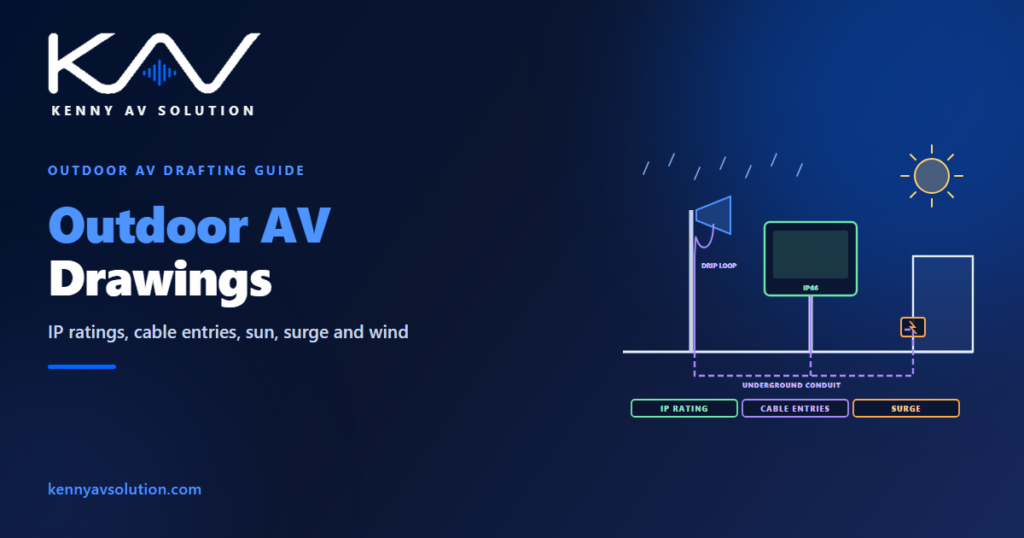
Outdoor AV drawings carry a risk that indoor drawings do not: the environment is trying to destroy the installation. Rain finds its way along cables, sun cooks enclosures and washes out screens, dust gets into fans, salt corrodes fixings, and a nearby lightning strike can travel down a loudspeaker line into the rack. Writing “outdoor loudspeaker” on a plan says almost nothing about any of that. The drawings need to state the environment each device sits in and the protection chosen for it.
Product ratings and operating limits come from the manufacturer, and the manufacturer’s data governs. Outdoor electrical work must follow the local electrical code for wet and damp locations; structural support and wind loads are for a structural engineer; lightning protection is for a specialist. The examples below are illustrative.
Read the IP code properly
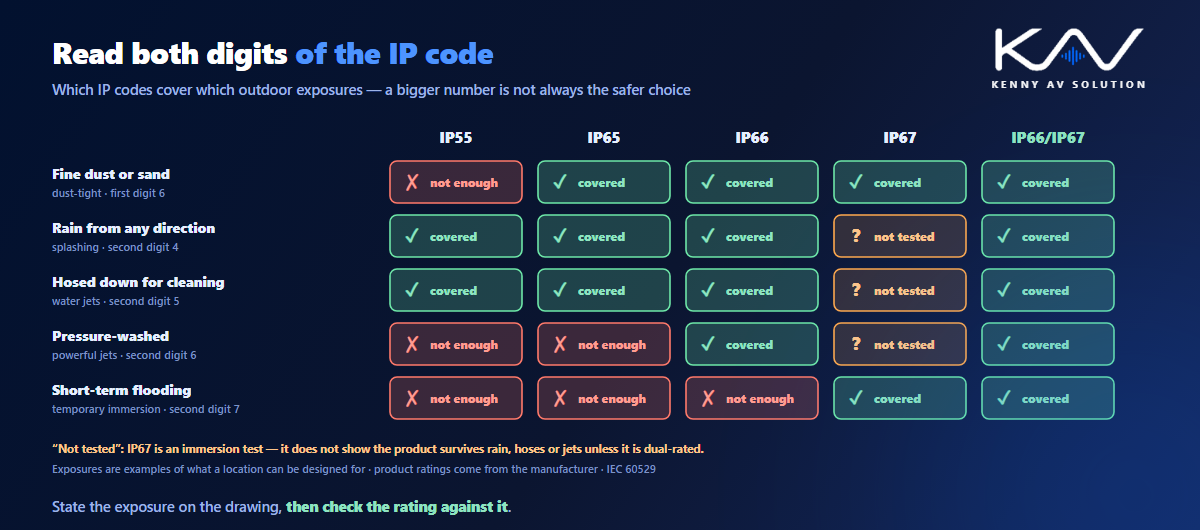
Outside North America, protection against dust and water is usually stated as an IP code under IEC 60529: two digits, such as IP65. The first digit covers solids — 5 is dust-protected, 6 is dust-tight. The second digit covers water — 4 is splashing from any direction, 5 is water jets, 6 is powerful jets, 7 is temporary immersion and 8 is continuous immersion under conditions the manufacturer states.
The trap is assuming a bigger number is always better. Up to 6, each water rating includes the ones below it. But 7 and 8 are immersion tests, not jet tests: a product rated only IP67 has not been shown to survive a hose or a pressure washer. Products meant for both are dual-rated, for example IP66/IP67. In North America, enclosures are often rated by NEMA type instead — for example Type 3R for rain, Type 4 for hose-directed water and Type 4X where corrosion resistance is also needed.
So the drawing should state the exposure, not just “weatherproof”: is the device under a canopy, out in the rain, hosed down when the area is cleaned, or somewhere that floods? Then the rating can be checked against it.
Water gets in through the cables
Most water damage outdoors does not come through the face of the device. It runs along the cable. Show on the details how each device is connected: cable entries from below rather than above, drip loops so water falls off before it reaches the entry, sealed cable glands rated to match the enclosure, and drainage at low points of conduit runs so water does not collect and wick into a back box. A device rated IP66 is not IP66 once the installer has drilled an open hole in the top of it.
Sun and heat
Direct sun creates two separate problems. The first is readability: a normal indoor display is unreadable in sunlight, so outdoor displays need high brightness and an anti-glare treatment, chosen from the manufacturer’s data for the position and orientation on the plan. The second is heat: sun on an enclosure can push the inside far above the air temperature. Check every device’s operating temperature range, and show the shading, ventilation or cooling the enclosures need. A position that faces the afternoon sun is worth flagging on the plan before it is fixed.
Surge and lightning
Any copper cable that runs outdoors, or between buildings, can carry a surge from a nearby lightning strike into the equipment at either end. Show surge protection where outdoor cables enter the building, bonded to the building’s grounding system as described in AV grounding and bonding. Between buildings, fibre avoids a conductive path altogether, which is one reason it is often specified for those links. Where the site has a lightning protection system, coordinate the AV with it rather than mounting equipment on the same structure without advice.
Cables, pathways and mounting
Outdoor cable needs a jacket rated for the conditions — sunlight resistance, wet locations, or direct burial where it goes underground without conduit. Show underground conduit routes, depths and pull points on the site plan, coordinated with landscaping and other services, and give every cable an ID in the cable schedule as usual; see also conduit and riser diagrams.
Mounting outdoors means wind load and corrosion. Loudspeakers, displays and cameras on poles or facades need supports designed for wind by a structural engineer, and fixings that will not corrode — stainless steel near the sea or around pools, as in marine AV drawings. Show the fixing details and the structure they fix to.
Sound outdoors
Outdoor loudspeakers have no walls to help them. Level falls with distance, wind and temperature bend the sound, and the neighbours hear it too. Lay the loudspeakers out from their coverage, as in loudspeaker coverage drawings, and note any noise limits that apply at the site boundary. Where the outdoor system is part of a paging system, its zones and line lengths need the same checks as indoors, usually with longer runs.
What an outdoor AV drawing set contains
- A site plan with every outdoor device, its exposure and its required rating.
- A device schedule listing the IP code or NEMA type, the operating temperature range and the mounting for each device.
- Connection details with cable entries from below, drip loops, glands and drainage.
- Surge protection at every building entry, with its bonding.
- Underground pathways with conduit routes, depths and pull points.
- Mounting details with fixings, materials and the supporting structure.
- Coverage plans for loudspeakers and, where relevant, cameras.
Outdoor work is common in stadiums, theme parks, hotels and residential projects, and the same checks apply to all of them.
Frequently asked questions
What IP rating does outdoor AV equipment need? It depends on the exposure at each location: rain, hosing for cleaning, pressure washing, dust or flooding. The first digit of the IP code covers dust and the second covers water, so state the exposure on the drawings and choose a rating that covers it, using the manufacturer’s data.
Is IP67 better than IP66? Not for every location. IP67 is a temporary immersion test and IP66 a powerful water jet test, and a product rated only IP67 has not been shown to resist jets. Products intended for both are dual-rated, for example IP66/IP67.
What is the difference between IP ratings and NEMA ratings? IP codes under IEC 60529 rate protection against solids and water with two digits and are used internationally. NEMA enclosure types, such as Type 3R, 4 and 4X, are used mainly in North America and also cover factors such as corrosion. They are not direct equivalents, so use the system the project specifies.
How do you stop water getting into outdoor AV equipment? Choose a rating that matches the exposure, then detail the connections: cable entries from below, drip loops, sealed glands that match the enclosure rating, and drainage at the low points of conduit runs so water cannot collect and track into the equipment.
Do outdoor AV systems need surge protection? Copper cables that run outdoors or between buildings can carry surges from nearby lightning, so surge protection is normally shown where they enter the building, bonded to the grounding system. Fibre between buildings avoids the conductive path entirely.
Need outdoor AV drawings?
Kenny AV Solution drafts AV documentation for integrators and consultants worldwide — site plans, device schedules with ratings, connection and mounting details, underground pathways and coverage plans, drawn to your standards and your title block. Send us the site plan and the equipment list. See our drafting services, grab the free AV CAD Drafting Standards Checklist, or schedule a quick call — we come back with a quote and timeline within one business day.