

An AV takeoff is the count of everything a project needs, taken from the drawings so the job can be priced: every device, every metre of cable, every back box, mount and connector. Integrators do it at tender, again when the design changes, and again before ordering. A takeoff is only as accurate as the drawings it is taken from, which makes it the most practical test a drawing set ever gets. If a set cannot be counted, it cannot be priced, and it probably cannot be built without surprises either.
Count devices from the schedule, check against the plans
Start with the device schedule, which should list every device once, by tag. Then count the symbols of each type on the plans and compare. Where the two agree, the count is reliable. Where they do not, you have found either a missing device or a deleted one still being ordered, and it needs an answer before the price goes out.
Count by type and by room, not just in total. A total of forty ceiling loudspeakers is not enough when two room types use different models, and room-by-room counts make it much easier to price changes later.
Cable: plan length is the minimum, not the answer
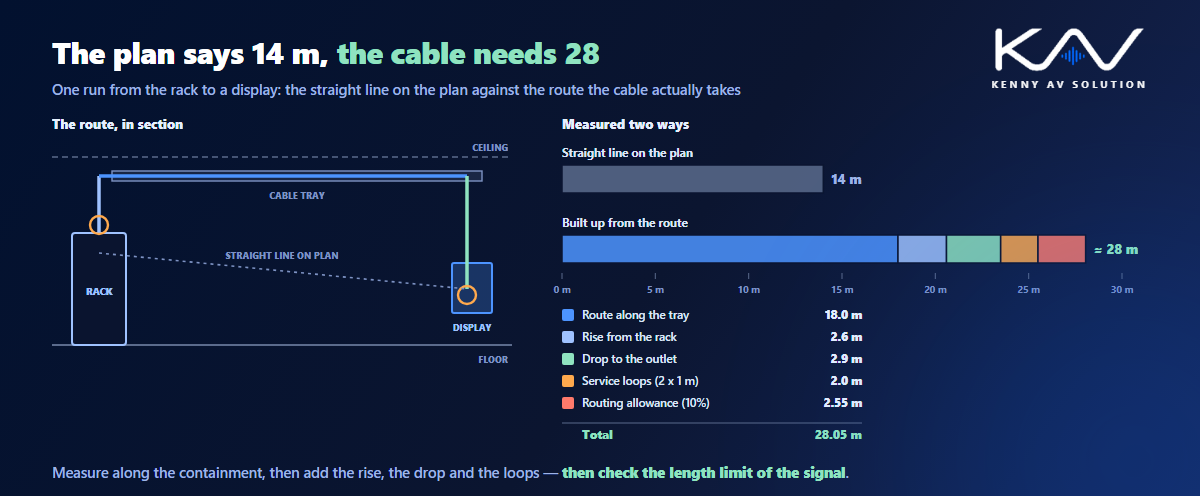
Cable is where takeoffs most often go wrong. A run measured along the plan is the shortest the cable could ever be; the installed length is longer. A realistic length adds:
- The rise from the rack or panel up to the containment.
- The route along the cable tray, which follows corridors rather than going straight across rooms.
- The drop down the wall to the outlet or device.
- Service loops at each end, so the device can be pulled out and re-terminated.
- A routing allowance for bends, offsets and obstacles the plan does not show.
Worked through for a single run, the difference is large. A display 14 m from the rack in a straight line on the plan might be 18 m along the cable tray. Add 2.6 m up from the rack to the tray, 2.9 m down the wall to the outlet, a metre of service loop at each end and a 10 percent routing allowance, and the run is about 28 m — twice the straight-line figure. Multiply that error across a few hundred runs and the cable line of the price is wrong by half.
The same point is made for network cabling in structured cabling drawings: the cable follows the containment, not the straight line. Check the result against the length limits of the signal; a run that crosses the limit once the real route is added needs an extender or a different design, not just more cable.
Waste, drums and reels
Cable is bought on drums or boxes of fixed length, and the offcut at the end of each drum is usually too short for another run. A takeoff that sums the lengths and divides by the drum size will come up short. Plan which runs come off which drum, or add a waste allowance, and keep it visible in the takeoff rather than hidden in a unit rate.
The things the drawings forget
A device count and a cable length are not the whole job. A complete takeoff also counts:
- Mounts, brackets, back boxes and floor boxes — see wall plate and connector details.
- Connectors and terminations at both ends of every cable.
- Rack accessories: blanks, vents, shelves, cable management and power distribution.
- Containment the AV contractor supplies, as opposed to what the electrician supplies, according to the responsibility matrix.
- Labels, licences, spares and consumables.
Where the drawings do not show something, the takeoff has to assume it, and every assumption is a risk in the price. List them with the takeoff, so they can be checked or turned into questions.
Gaps in the takeoff are gaps in the drawings
Every time a takeoff needs an assumption, it has found something the drawings do not say: a cable with no route, a device with no mounting detail, a room with symbols but no tags. On a tender those become exclusions or contingencies; during the project they become RFIs. Drawings with complete schedules, consistent tags and stated routes make the takeoff quick and the price defensible.
Frequently asked questions
What is an AV takeoff? A count of every device, cable, mount, connector and accessory a project needs, taken from the drawings and schedules so the project can be priced and ordered.
How do you count devices for an AV takeoff? Start from the device schedule, count the symbols of each type on the plans, and compare the two by room. Any difference is either a missing or a deleted device and needs resolving before pricing.
How do you estimate AV cable lengths from drawings? Measure along the containment route, not straight across the plan, then add the rise, the drop, service loops at both ends and a routing allowance, and check the result against the signal’s length limits.
How much waste should an AV cable takeoff allow? It depends on the drum or box size and the run lengths, because the offcut at the end of each drum is often too short to use. Plan runs against drum lengths or add a visible waste allowance.
What do AV takeoffs commonly miss? Mounts, back boxes and floor boxes, connectors at both ends of each cable, rack accessories, containment the AV contractor supplies, labels, licences, spares and consumables.
Need drawings you can price from?
Kenny AV Solution drafts AV documentation for integrators, consultants and design-build teams worldwide — device schedules that match the plans, cable schedules with routes and lengths, mounting details and complete rack elevations, all drawn to your standards and your title block. See our drafting services, get an existing set checked with a drawing set review, or schedule a quick call — we come back with a quote and timeline within one business day.