
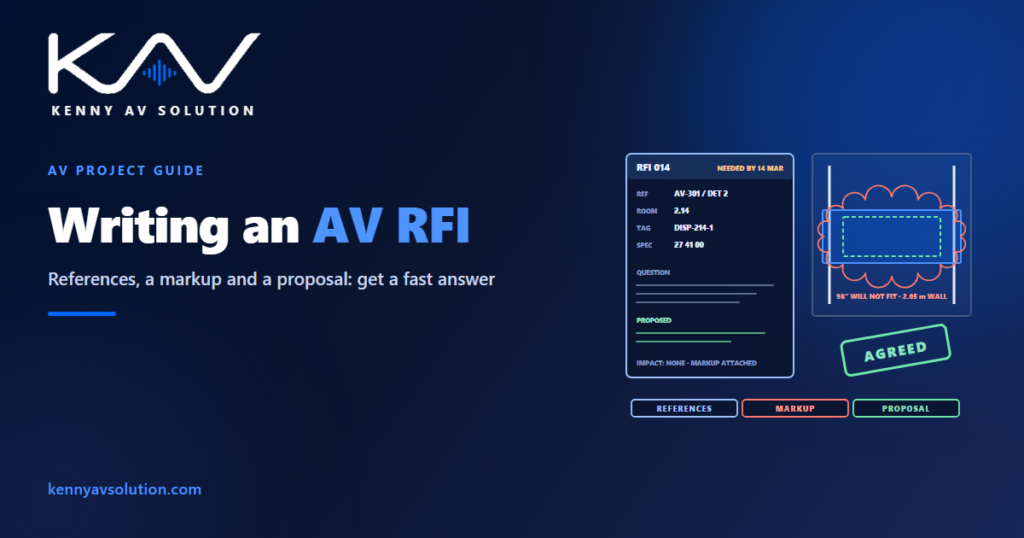
An AV RFI — a request for information — is how an integrator asks the design team a question the contract documents do not answer. Every one costs time on both sides, and the way it is written decides how much. A vague RFI gets a vague answer, or a question back, and a week disappears. A clear one, with the right references, a marked-up drawing and a proposed solution, often gets answered in a line. The difference is mostly drafting discipline.
How RFIs are submitted, numbered, answered and paid for is set by the contract and the project’s procedures — in the United States often on a standard form such as AIA G716. Follow the project’s process; what follows is common practice.
Before you send it
Many RFIs should not exist. Before writing one, check that the answer is not already in the documents: the drawings, the specification, the addenda, the responsibility matrix and the answers to earlier RFIs. A design team that keeps answering “see sheet AV-201” stops reading your RFIs carefully.
Then decide what kind of question it is. A real conflict or missing information is an RFI. A wish to change the design — a different product, a cheaper route — is usually a substitution request or a change proposal, which most contracts handle through a different process.
One question per RFI
An RFI with five questions is answered when the last one is answered, and often only partly. Split them. One question per RFI can be answered, tracked and closed on its own, and the answers can be traced back to the drawing change each one caused.
What an answerable RFI contains
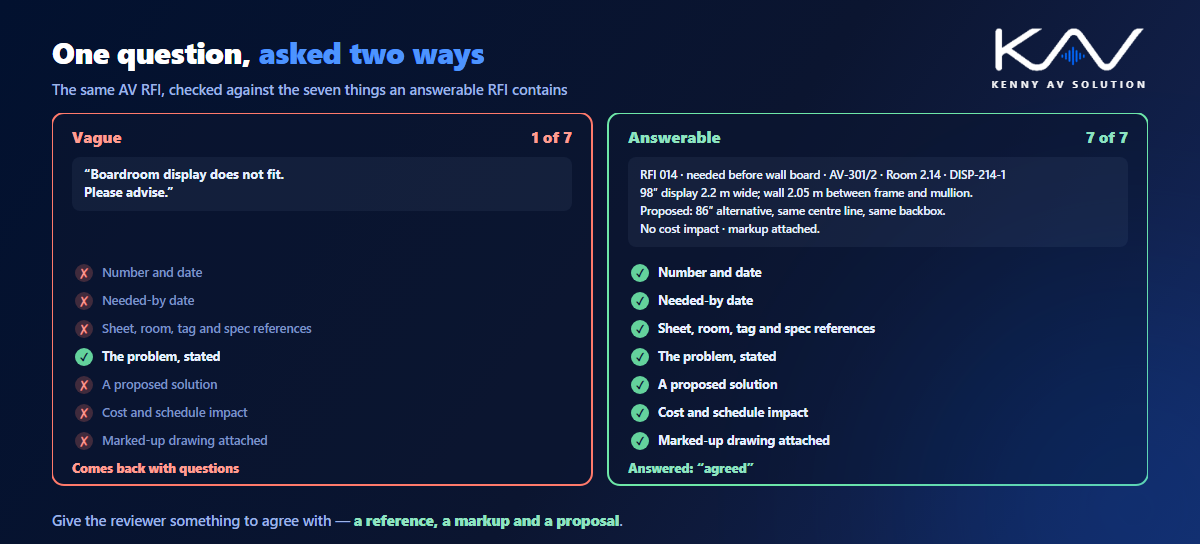
- A number and a date, in the project’s numbering sequence.
- A needed-by date, tied to the work it holds up — not “ASAP”.
- References: the sheet and detail, the room number and grid lines, the device tags and the specification section.
- The problem in one or two sentences: what the documents say, and why it cannot be built as shown.
- A proposed solution, so the reviewer can simply agree or correct it.
- The impact, if any, on cost or schedule, stated plainly.
- A marked-up drawing showing the problem and the proposal.
The same question, asked two ways
“Boardroom display does not fit. Please advise.” is an RFI that will come back with a question: which display, which wall, what does not fit, and what do you want to do about it? It names the problem and nothing else.
The answerable version says: RFI 014, needed by the date the wall is boarded. Sheet AV-301, detail 2, Room 2.14, display DISP-214-1, Section 27 41 00. The specified 98″ display is 2.2 m wide, but the wall between the door frame and the window mullion is 2.05 m. Proposed: change to the 86″ display listed as an alternative, centred on the same line, with no change to the backbox. No cost impact. Markup attached. The reviewer can answer “agreed” in one word.
Show it, don’t describe it
“The display in the boardroom conflicts with the ceiling” takes three emails to understand. A marked-up excerpt of the wall elevation with the clash clouded, the dimensions shown and the proposed new mounting height noted takes one look. Cloud the area, keep the reference to the original sheet and revision, and name the tags exactly as they appear on the drawings, so nobody has to guess which display you mean.
Where the question is about coordination with another trade — a loudspeaker on top of a sprinkler, a floor box in a structural beam — overlay the relevant part of their drawing on yours, as described in AV trade coordination.
Track every RFI to a drawing change
Keep an RFI log: number, subject, date sent, date needed, date answered, status and the drawings affected. When an answer changes the design, the change goes onto the drawings at the next revision, clouded and noted, under the same revision control as any other change. An answer that lives only in an email is lost the day someone installs from the drawings, and missing again when the as-builts are prepared.
RFIs as a signal about the drawings
A handful of RFIs is normal on any project. A steady stream about the same things — missing mounting heights, tags that do not match between sheets, connections shown on the signal flow but not in the cable schedule — points to a problem with the drawing set itself. Those are the issues worth catching before issue, through a drawing set review, rather than one RFI at a time on site.
Frequently asked questions
What is an RFI in AV construction? A request for information: a formal question from the integrator or contractor to the design team about something the drawings and specification do not make clear, or where they conflict. It is answered in writing and tracked, and the answer may change the drawings.
What should an AV RFI include? A number, the date and a needed-by date, references to the sheet, detail, room, device tags and specification section, a short statement of the problem, a proposed solution, any cost or schedule impact, and a marked-up drawing showing the issue.
Should an RFI include a proposed solution? Yes, where you can. A proposed solution lets the reviewer agree or correct it rather than design from scratch, which usually gets a faster and clearer answer.
What is the difference between an RFI and a change request? An RFI asks for information or resolves a conflict in the documents. A request to change the design, such as substituting a product, is usually handled through a separate substitution or change process set by the contract.
How do you reduce the number of RFIs on an AV project? Issue drawings that are complete and consistent: mounting heights stated, tags matching across sheets, every connection in the cable schedule, and the drawings checked against the specification before issue. Recurring RFIs usually point to the same few gaps in the set.
Need AV drawings that raise fewer RFIs?
Kenny AV Solution drafts AV documentation for integrators and consultants worldwide — complete, consistent sets with tags, heights and schedules that match, plus RFI markups and revised sheets when answers come back, drawn to your standards and your title block. See our drafting services, get an existing set checked with a drawing set review, or schedule a quick call — we come back with a quote and timeline within one business day.