
If you’re an AV integrator or system designer trying to decide which software to use for your CAD drawings, you’ve likely run into the same three names over and over: AutoCAD, D-Tools, and XTEN-AV. Each one has a dedicated following — and for good reason. But they serve different needs, different team sizes, and different workflow styles.
This guide breaks down the best AV CAD software in 2026, compares the top platforms head-to-head, and helps you figure out which one is the right fit for your business.
Why the Right AV CAD Software Matters
The software you use for AV design documentation directly affects how fast you can produce drawings, how accurate your proposals are, and how professional your submittals look. Poor tool choices slow down your sales cycle, introduce errors into installation, and make it harder to scale your team.
In 2026, the AV industry has more software options than ever — but the three platforms that dominate the professional integration space remain AutoCAD, D-Tools, and XTEN-AV. Let’s look at each one in depth.
AutoCAD: The Industry Standard for AV CAD Drawings
AutoCAD by Autodesk has been the gold standard in technical drafting for decades. In the AV world, it’s the tool most commonly used by dedicated CAD drafters, systems designers at large integrators, and outsourced AV documentation teams like Kenny AV Solution.
What AutoCAD Does Well for AV
- Precision drafting: AutoCAD is built for exact, to-scale drawings. Floor plans, reflected ceiling plans, rack elevations, and riser diagrams all come out clean and accurate.
- Custom AV symbol libraries: Using AVIXA-standard symbols or custom block libraries, designers can drop in AV equipment, cable runs, conduit paths, and control zones with speed and consistency.
- Universal compatibility: DWG files are the lingua franca of the construction world. Architects, MEP engineers, and general contractors all work in DWG — so your AV drawings drop seamlessly into their coordination sets.
- Unlimited flexibility: AutoCAD doesn’t constrain your drawing style. Signal flow diagrams, point-to-point wiring diagrams, equipment schedules — you can build any document format you need.
AutoCAD Limitations for AV Integrators
- No built-in AV workflow: AutoCAD is a general drafting tool. It doesn’t natively understand AV systems — you’re building everything from scratch or from a custom template library.
- Steep learning curve: For non-drafters, AutoCAD takes months to learn properly. Most AV companies either hire a dedicated drafter or outsource.
- Cost: AutoCAD LT runs ~$380/year; the full AutoCAD suite is ~$1,875/year per user. Add Autodesk’s suite subscriptions and costs climb quickly.
- No proposal or quoting integration: AutoCAD is drawings only — it doesn’t connect to your pricing, proposal, or project management tools.
Best for: Larger integrators with dedicated design staff, firms producing submittal-quality drawings, and anyone needing DWG compatibility with construction teams.
D-Tools: AV Business Software with Drawing Capabilities
D-Tools SI (System Integrator) is purpose-built for the AV and systems integration industry. It’s less of a pure CAD tool and more of an end-to-end business platform — covering proposals, quoting, project management, and documentation all in one.
What D-Tools Does Well for AV
- All-in-one workflow: From initial proposal through installation and service, D-Tools keeps everything in one platform. Your equipment database drives your drawings, your quotes, and your purchase orders.
- Built-in AV product library: D-Tools maintains a database of thousands of AV products with specs, images, and pricing — saving enormous time on data entry.
- Visio-based diagrams: D-Tools uses Microsoft Visio for its drawing layer, making it accessible to people who aren’t AutoCAD experts. Signal flow diagrams, system diagrams, and floor plans can be created without a drafting background.
- Project management integration: Field technicians, project managers, and sales teams all work from the same platform — reducing miscommunication between departments.
D-Tools Limitations
- Drawing quality ceiling: Visio-based drawings rarely meet the quality bar required for construction submittals or architectural coordination. Most integrators using D-Tools still outsource complex drawings to AutoCAD.
- Cost: D-Tools SI starts around $250–$400/month per user, which adds up quickly for small teams.
- Windows-only: D-Tools SI is a Windows desktop application — no Mac, no browser-based access without workarounds.
- Complexity: The platform is powerful but has a significant onboarding curve. Many integrators use only 30–40% of its features.
Best for: Mid-size to large integrators who want proposal-to-installation workflow in one tool, and who need quoting and project management more than architectural-quality drawings.
XTEN-AV: The Modern Cloud-Based AV Design Platform
XTEN-AV is the newest of the three platforms and has gained significant traction in the AV industry since its launch. It’s a cloud-based, browser-accessible platform built specifically for AV system design — combining drawing tools, product libraries, and proposal generation in a modern UI.
What XTEN-AV Does Well
- Cloud-native and cross-platform: XTEN-AV runs in a browser, on any OS, accessible from anywhere. For remote teams and growing integrators, this is a major advantage.
- AV-first design: Unlike AutoCAD (general) or D-Tools (business-focused), XTEN-AV is purpose-built around AV drawing standards. Templates, symbols, and workflows are all AV-specific out of the box.
- Fast proposal generation: System designs created in XTEN-AV can be directly converted into client-facing proposals — reducing the gap between design and sales.
- Collaboration features: Multiple team members can work on a project simultaneously, with version history and comment threads built in.
- Active development: XTEN-AV releases updates frequently and has been actively expanding integrations with manufacturers and distributors.
XTEN-AV Limitations
- Less mature than AutoCAD/D-Tools: XTEN-AV is a younger platform. Some integrators report that drawing precision and output quality still lag behind AutoCAD for complex architectural projects.
- DWG export limitations: While XTEN-AV offers PDF and some export options, DWG compatibility for construction coordination isn’t as seamless as native AutoCAD files.
- Pricing varies by tier: XTEN-AV pricing depends on features and team size — some advanced features require higher-tier plans.
Best for: Smaller and mid-size integrators who want a modern, cloud-based workflow, teams designing systems quickly for proposal-first sales processes, and designers who want AV-native tools without AutoCAD’s learning curve.
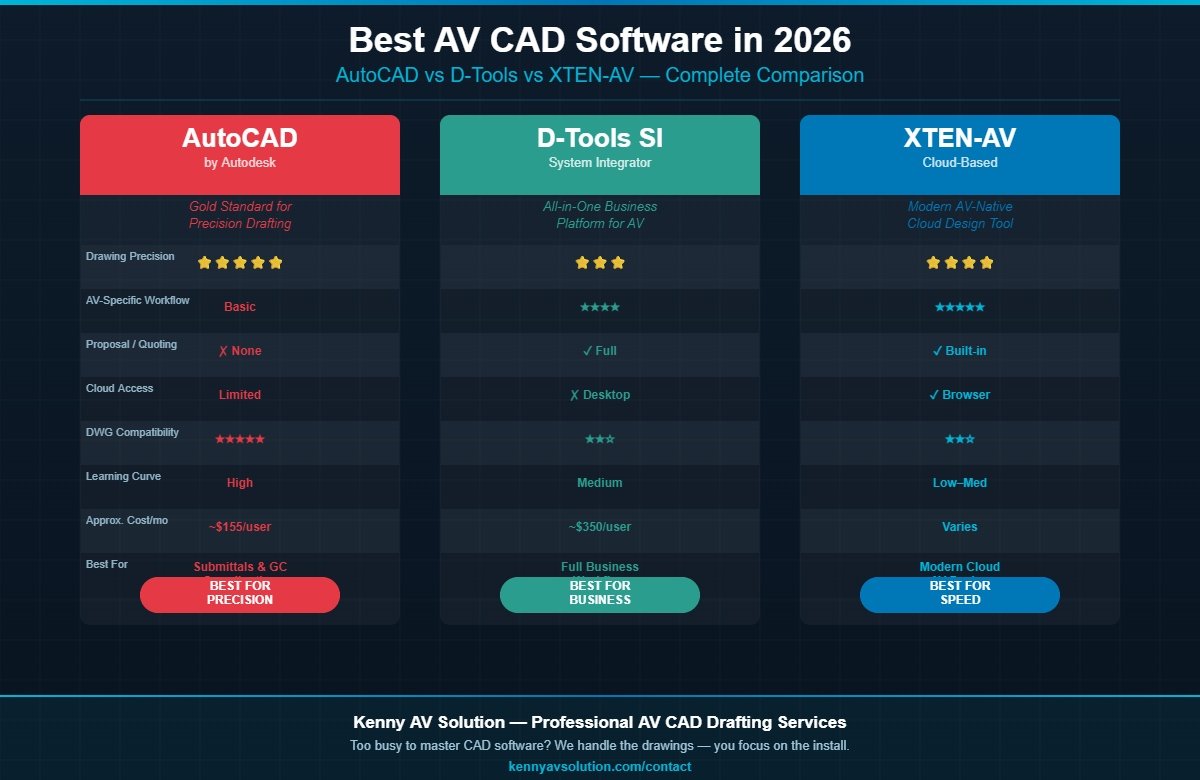
AutoCAD vs D-Tools vs XTEN-AV: Side-by-Side Comparison
Here’s a quick comparison across the categories that matter most to AV integrators:
| Feature | AutoCAD | D-Tools SI | XTEN-AV |
|---|---|---|---|
| Drawing Precision | ★★★★★ | ★★★☆☆ | ★★★★☆ |
| AV-Specific Workflow | ★★☆☆☆ | ★★★★☆ | ★★★★★ |
| Proposal/Quoting | ✗ | ★★★★★ | ★★★★☆ |
| Cloud / Remote Access | Limited | ✗ | ★★★★★ |
| DWG Compatibility | ★★★★★ | ★★☆☆☆ | ★★☆☆☆ |
| Learning Curve | High | Medium | Low–Medium |
| Price (approx/user/mo) | ~$155 | ~$300–$400 | Varies |
| Best For | Submittal-quality drawings | Full business workflow | Modern cloud design |
Which AV CAD Software Should You Choose in 2026?
The honest answer: it depends on your business model and what you need the software to do.
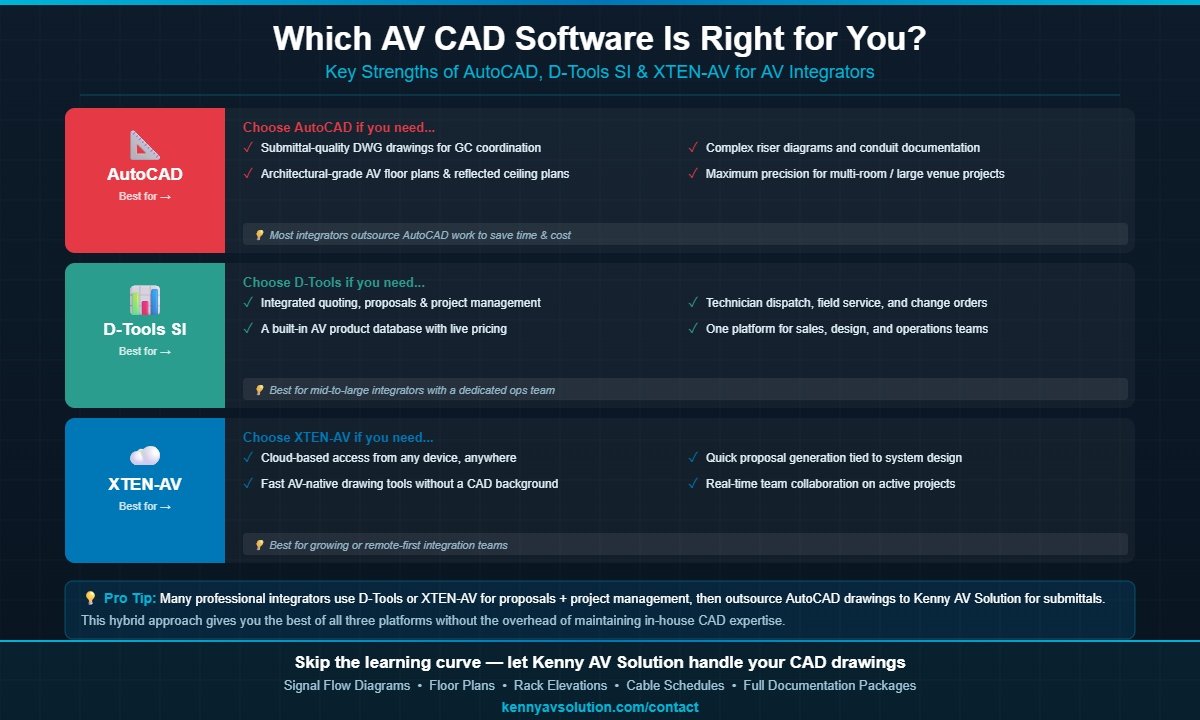
- If you need submittal-quality drawings that coordinate with architects and GCs, AutoCAD is still the gold standard. Many integrators outsource this work to dedicated CAD drafters rather than maintaining the skill in-house.
- If you want a full business platform — from quoting to installation management — D-Tools SI is the most mature solution in the AV industry, despite its higher cost and complexity.
- If you want modern, cloud-based AV design with a lower learning curve and built-in proposal features, XTEN-AV is worth a serious look, especially for growing teams or remote workflows.
Many professional integrators actually use a combination: D-Tools or XTEN-AV for quoting and project management, plus AutoCAD (in-house or outsourced) for the final drawing package that goes to the GC and client.
Don’t Have Time to Master CAD? Outsource It.
For many AV integrators, the real answer to the “which CAD software” question is: none of them. Learning AutoCAD, managing D-Tools, or onboarding your team to XTEN-AV all take time and money — resources that are often better spent selling, managing projects, and serving clients.
That’s where Kenny AV Solution comes in. We specialize in professional AV CAD drafting for integrators across North America. You send us your system design, notes, and equipment list — we deliver clean, accurate AutoCAD drawings ready for submittal or field installation.
Our services include signal flow diagrams, AV floor plans and reflected ceiling plans, rack elevations, cable schedules, riser diagrams, and complete AV documentation packages.
Contact Kenny AV Solution today to get a quote on your next project. Skip the software learning curve — and get professional drawings delivered fast.