
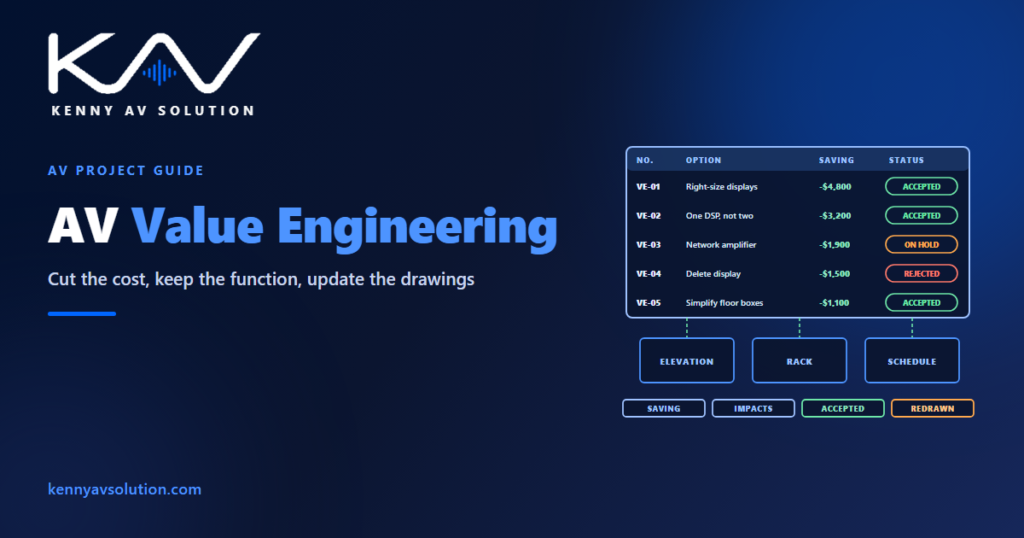
AV value engineering is the stage where a project that came in over budget looks for savings without losing what the client actually needs. It happens on almost every job. Done well, it trims cost and keeps the function. Done badly, it removes a processor here and downsizes a display there, and nobody follows the change through the drawings until the installer finds a rack with no space for the amplifier that replaced two smaller ones, or a cable schedule full of runs to a device that no longer exists.
Value engineering is not just cutting
The idea behind value engineering is to keep the function and reduce the cost. Removing a feature the client asked for is a scope reduction, which may be the right call, but it is a different decision and should be presented as one. Useful AV value engineering usually comes from:
- Right-sizing — a display chosen by habit rather than by the viewing distance, or an amplifier channel count with spare capacity nobody planned to use.
- Consolidation — one processor doing the work of two, or networked audio replacing analogue runs.
- Infrastructure — containment, back boxes and cable routes that can be simplified once device positions are firm.
- Standardisation — the same products across room types, so spares and support are simpler.
Right-sizing should be checked, not guessed. A smaller display is only a saving if it still meets the viewing requirement, as worked through in display sizing with DISCAS.
Every option needs an impact list
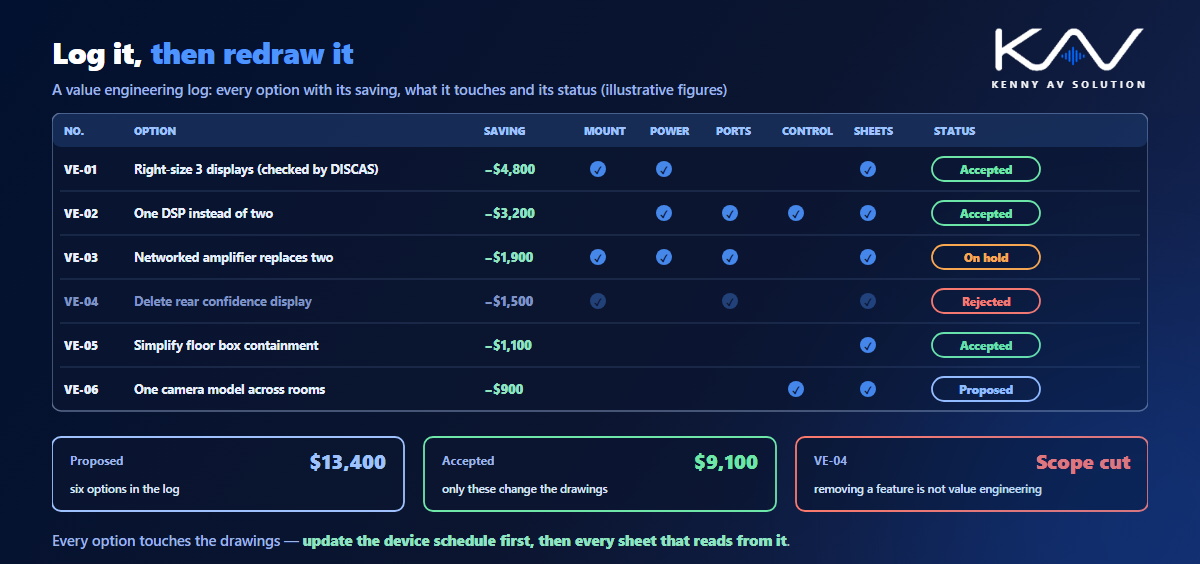
A value engineering option is not just a product swap and a saving. Each one changes other things, and the people deciding need to see them before they accept it. For each option, list what it touches:
- Mounting, backing and space — different size, weight or depth.
- Power and heat — which change the rack power and heat load.
- Ports and connections — fewer inputs, different signal types, new cables or adapters.
- Control — a different device may need a different driver and different programming.
- Other trades — electrical, data, joinery and structure may all depend on the original choice.
- The drawings — every sheet and schedule that shows the affected devices.
The last point is where most value engineering goes wrong. The saving is agreed in a meeting, the email gets forwarded, and the drawings are updated piecemeal or not at all.
Keep a value engineering log
Track every option in one log, numbered like RFIs: the option, the saving, the impacts, the affected tags and sheets, who proposed it and its status — proposed, accepted, rejected or on hold. Rejected options stay in the log with the reason, because the same idea will be proposed again later and the answer should not have to be worked out twice.
Only accepted options change the drawings, and when they do, the change goes through the same revision control as any other: clouded, noted in the revision block and traceable to the log number. Update the device schedule first, since every other drawing reads from it.
Alternates and contract changes
On tendered projects, savings are often priced as alternates — add or deduct options listed in the bid documents so the client can choose after seeing the prices. Where a change affects products named in the specification, it may need to go through a substitution or change process rather than a drawing revision alone; see AV drawings vs specifications. Who carries the cost of re-drawing is a commercial question, but the drawings need to be updated either way.
The cheapest time is early
The same saving costs very little at concept stage and a lot after the shop drawings are approved, the joinery is in production and the rack is built. Value engineering late in a project usually saves less than it appears to, once the redrawing, the re-coordination and the delay are counted. If the budget is likely to be tight, test the major cost drivers — display sizes, processing architecture, room counts — while the design is still on paper. The best time to test them is during the AV needs analysis, before the room data sheets are signed off.
Frequently asked questions
What is value engineering in AV? Finding ways to reduce the cost of an AV system while keeping the function the client needs, such as right-sizing equipment, consolidating processing or simplifying infrastructure. Removing features is a scope reduction rather than value engineering.
What should a value engineering proposal include? The change, the saving, and its impacts on mounting, power and heat, connections, control, other trades and the drawings, with the affected device tags and sheets listed so the decision can be made with the full picture.
How do you track value engineering changes? In a numbered log with the saving, impacts, affected tags and sheets, and status. Only accepted options change the drawings, and those changes go through normal revision control, traceable to the log number.
What is an add or deduct alternate? A priced option in the bid documents that the client can accept or decline after seeing the cost, used to test savings or additions without changing the base design.
When should AV value engineering happen? As early as possible. A change made at concept stage costs little; the same change after shop drawings, joinery and rack builds can cost more in redrawing, coordination and delay than it saves.
Need drawings updated after value engineering?
Kenny AV Solution drafts AV documentation for integrators, consultants and design-build teams worldwide — including revised drawing sets after value engineering, with every affected elevation, schedule and signal flow updated and clouded, all drawn to your standards and your title block. See our drafting services, get an existing set checked with a drawing set review, or schedule a quick call — we come back with a quote and timeline within one business day.