
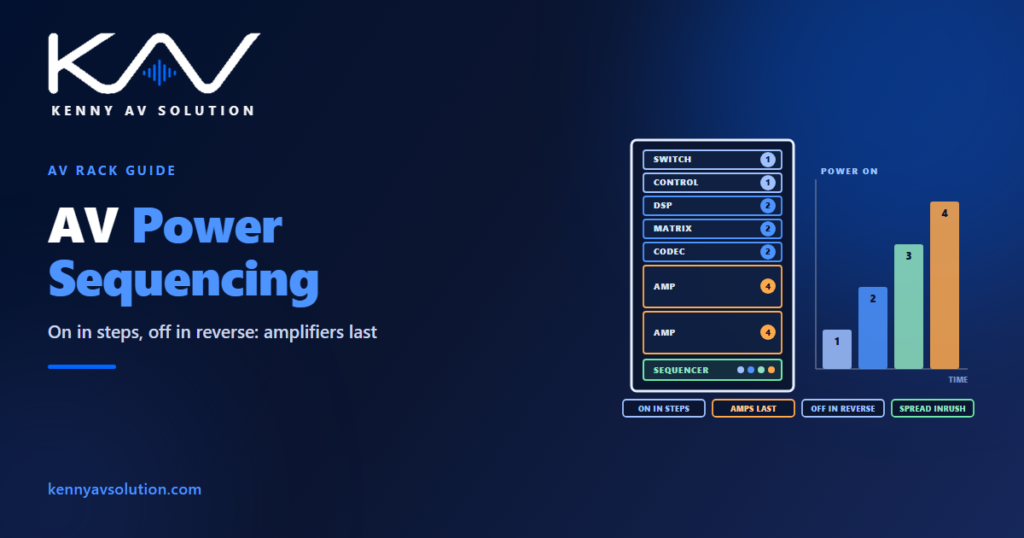
AV power sequencing is the order in which the equipment in a rack is switched on and off. Get it right and the system comes up quietly every morning. Get it wrong and the loudspeakers thump when the amplifiers come on before the processors have settled, a breaker trips when every power supply starts at once, or a display hunts for a signal from a switch that has not finished booting. None of that is a hardware fault, and none of it shows up on a drawing that only says “rack power”. The sequence is a design decision, and it belongs on the drawings.
Electrical circuits, outlets and protective devices are designed by the electrical engineer and installed under the local electrical code. Start-up behaviour, inrush current and standby modes vary by product, and the manufacturer’s documentation governs. The sequence below is common practice and the figures are illustrative.
Why sequence at all
Three problems drive it:
- Thumps and pops. A processor or mixer settling as it powers up can send a transient to the amplifiers. If the amplifiers are already on, the loudspeakers reproduce it. Amplifiers last on and first off avoids it.
- Inrush current. Many power supplies draw a brief surge of current at switch-on, much higher than their running load. One device does not matter. A rack of them switched together can trip the breaker that copes perfectly well with the running load.
- Boot order. Networked systems have dependencies. Endpoints expect the network switch to be ready, the control processor expects the devices it controls to answer, and some devices give up looking for a source or a controller if they boot too early.
The usual order
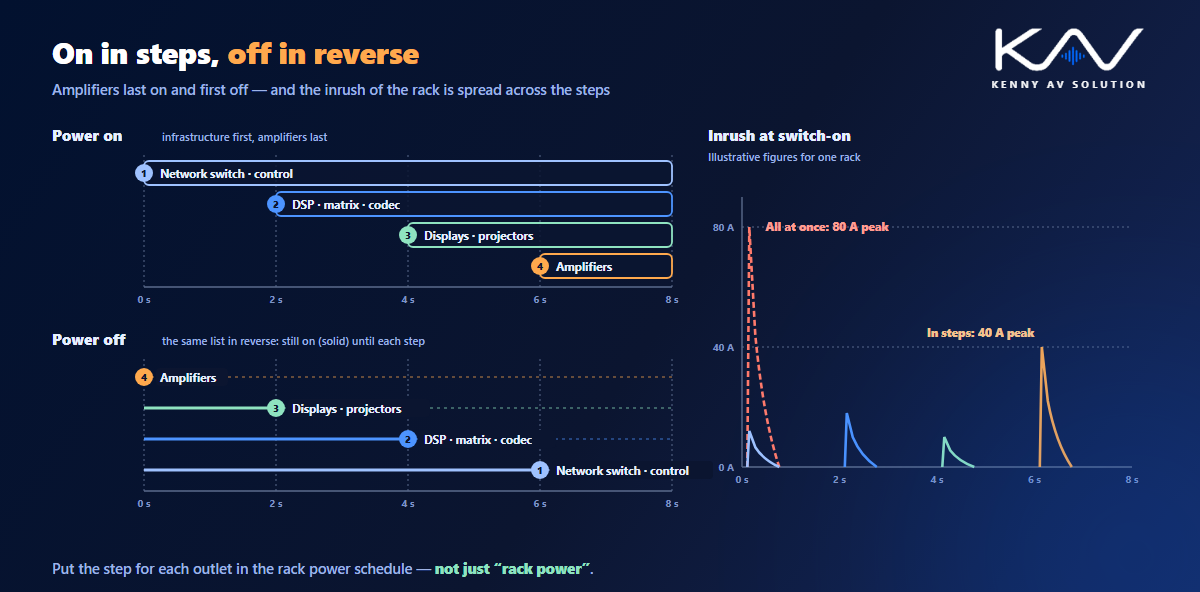
A typical rack powers up in steps, a few seconds apart:
- Infrastructure — network switches and the control processor, which often stay on permanently.
- Processing and sources — DSP, matrix switchers, codecs, media players and receivers.
- Displays and projectors — usually switched by control commands rather than by mains power.
- Amplifiers — last, once everything feeding them is stable.
Power-down is the same list in reverse: amplifiers first, infrastructure last or not at all. The delays between steps depend on the equipment; a few seconds is typical, but a codec or a processor that takes longer to boot sets the pace for the step after it.
Mains switching, standby or control commands
There are three ways to make the sequence happen, and most systems use more than one:
- A power sequencer or sequenced power distribution unit in the rack, switching outlets in steps with set delays, triggered by a contact closure, a network command or a front-panel switch.
- Network or contact standby on the equipment itself. Many modern amplifiers and processors can be put in standby by the control system without removing mains power, which is quieter and avoids inrush altogether.
- Control system logic that sends the commands in order: wake the codec, switch on the display, take the amplifiers out of standby.
Whichever method is used, write it down. “System on” is a button on a touch panel; what it actually does belongs in the control system drawings, and the outlets and relays it uses belong in the control I/O schedule.
What belongs on the drawings
Sequencing touches three documents, and they need to agree:
- The rack elevation shows the sequencer or switched power distribution, its position in the rack and the feeds into it, as with any other rack elevation.
- The rack power schedule gets a column for the outlet and step each device is on, alongside the loads that make up the rack power and heat load. Devices on protected power, and devices that are never switched, are marked as such.
- The control documentation states the power-on and power-off sequence, the delays, what triggers it, and what happens on a fire alarm or loss of power.
The device tags must be the same in all three, keyed to the device schedule. A sequencer drawn on the elevation with no outlet assignments is a box, not a design.
Spread the inrush
Group the high-inrush devices so they do not all start in the same step. Amplifiers with large power supplies, video wall processors and some displays are the usual suspects. Spread them across steps, or across circuits, and the peak current at switch-on stays close to what a single step draws instead of the sum of the whole rack. Where the manufacturer offers a soft-start or staggered power-up feature, note it on the schedule, because it changes how the rack can be grouped.
Inrush is also why the circuit count from the running load is not always enough. Give the electrical engineer the running load, the devices with significant inrush and the sequence you intend, and let them confirm the protective devices. The same rack-level coordination applies to grounding and bonding.
Loss of power and restart
Decide what the rack should do when the power comes back after an outage. Equipment that returns to its last state can bring the amplifiers up before the processors, undoing the whole sequence. Many sequencers and switched distribution units can be set to stay off, or to restart in sequence, after a power failure. State which, on the drawings, and check it during commissioning by actually removing the power.
Devices on a UPS ride through short interruptions and may not restart at all. That is usually what you want for network switches and control processors. It is rarely practical for large amplifiers, which is one reason the protected-power list is almost never the whole rack.
Frequently asked questions
What is AV power sequencing? The order in which AV equipment is powered on and off, usually in timed steps. It prevents loudspeaker thumps, limits the combined inrush current at switch-on and makes sure devices boot after the equipment they depend on.
In what order should AV equipment be turned on? Network switches and the control processor first, then processors and sources, then displays, and amplifiers last. Turn everything off in reverse, with the amplifiers first.
Why do amplifiers go on last and off first? Equipment feeding the amplifiers can produce transients while it powers up or down. If the amplifiers are on at that moment, the loudspeakers reproduce the transient as a thump or pop.
Do modern AV systems still need a power sequencer? Not always. Many amplifiers and processors support standby controlled over the network or by contact closure, so the control system can manage the order without switching mains power. A sequencer is still common where equipment does not support standby or where inrush needs to be spread.
Where is power sequencing shown on AV drawings? The sequencer or switched power distribution appears on the rack elevation, the outlet and step for each device appear in the rack power schedule, and the sequence, delays and triggers are written into the control documentation.
Need rack drawings that cover the details?
Kenny AV Solution drafts AV documentation for integrators, consultants and design-build teams worldwide — rack elevations, power schedules with outlet and sequence assignments, control I/O schedules, signal flow and cable schedules, all with tags that match across every sheet and drawn to your standards and your title block. See our drafting services, get an existing set checked with a drawing set review, or schedule a quick call — we come back with a quote and timeline within one business day.