
AV acoustics coordination is about the ways an AV installation can damage the room it is meant to serve. The acoustician designs the walls, the ceiling, the treatment and the ventilation noise targets. Then the AV contractor cuts back boxes into the sound-rated wall, puts a rack with cooling fans in the meeting room, and fixes a ceiling microphone next to an air diffuser. None of that shows up as an acoustics problem until the room is in use — and by then the drawings are where people go to find out whose decision it was.
Acoustic targets, wall ratings and treatment are set by the acoustician and the architect, and fire-rated walls have their own rules for openings and penetrations under the local code. What follows is common coordination practice for the AV share of the work.
The acoustician’s numbers are assumptions on your drawing
Reverberation time and background noise targets are not AV deliverables, but the AV design depends on them: microphone pickup, loudspeaker layout and echo cancellation all work better in a room that is quiet and controlled. Record the targets on the drawings as stated assumptions, attributed to whoever set them, as described in loudspeaker coverage drawings. The rest of this post is about not undermining them.
Back boxes in sound-rated walls
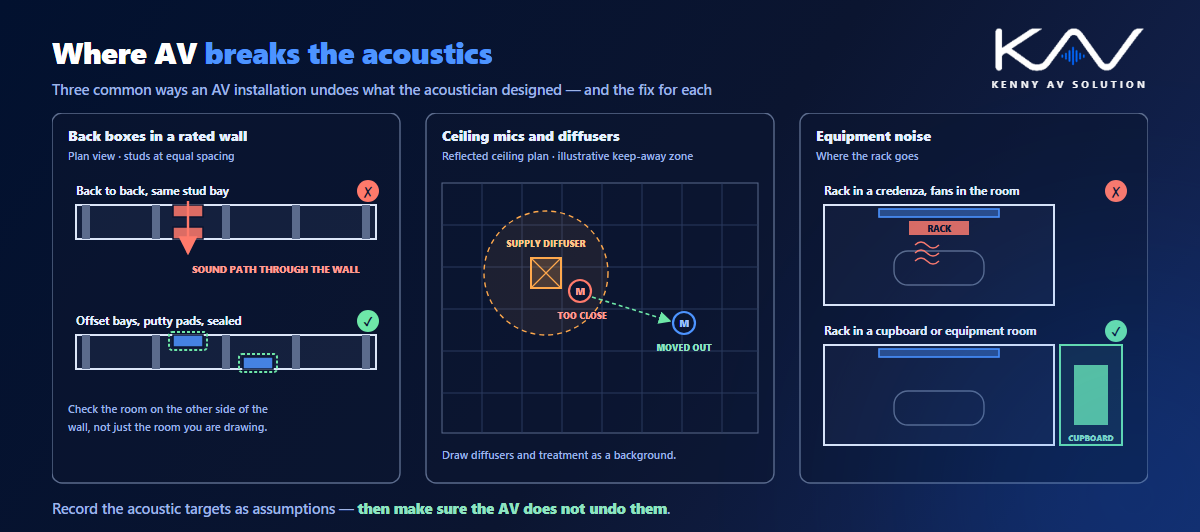
A wall between two meeting rooms is often built to a sound isolation rating, with insulation in the cavity and sealed joints. A back box is a hole in one side of that wall. Two back boxes in the same stud bay, one on each side, line up into a short path straight through the wall, and the isolation the acoustician designed is lost around a few square centimetres of plastic. The same happens with wall plates for displays on both sides of a partition, which is exactly where AV tends to put them.
- Never place boxes back to back. Offset them into different stud bays.
- Where the acoustician or the wall system requires it, wrap the box in acoustic putty pads or a backing box, and seal around it.
- In fire-rated walls, the separation and protection of boxes are code requirements as well as acoustic ones; check them with the architect.
Show box positions dimensioned on the wall elevations, with a typical detail for boxes in rated walls, and check them against the room on the other side of the wall, not just the room you are drawing.
Cables through walls and over the top
Every cable that crosses a rated wall is another opening. Route it through a sleeve sealed with acoustic sealant, and fire-stopped where the wall is fire-rated, rather than through a hole cut on site. Watch partitions that stop at the suspended ceiling: sound travels over the top through the ceiling void, and a cable tray running across the top of the wall can be the reason an acoustician specified a barrier there in the first place. The same principle applies, at a much higher standard, in broadcast studios, where every penetration is designed.
AV equipment makes noise
Projectors, some displays, codecs, amplifiers and network switches have fans. One device in a quiet room is noticeable; a rack of them in a credenza under the display can raise the background noise above the target the acoustician designed for. Keep racks out of rooms that need to be quiet, in a cupboard or an equipment room, as part of the decision about rack power and heat. Where equipment has to be in the room, choose quiet models or low-noise modes, ventilate enclosures without making them loud, and state the assumption on the drawings.
Microphones and the ceiling
Ceiling microphones hear everything above the table, including the air diffuser beside them. Coordinate them on the reflected ceiling plan with the mechanical layout, keeping them away from supply diffusers and return grilles and from noisy equipment above the ceiling. The same goes for acoustic clouds and baffles: a microphone or loudspeaker that ends up behind or under a cloud does not behave the way its coverage drawing says. Draw the treatment as a background on the AV ceiling plan, so the clashes are visible before the ceiling is built.
Treatment and the walls AV needs
Absorptive wall panels and AV compete for the same surfaces. The front wall of a meeting room wants a display; the acoustician may want treatment on the wall opposite it, or on the side walls, to control reflections back to the microphones. Agree which walls are treated before fixing display positions, cameras and wall plates, and show the treatment on the elevations. In video conferencing rooms, where the microphones and echo cancellation depend on a controlled room, this coordination matters most.
What to put on the drawings
- The acoustic targets, as stated assumptions with their source.
- Wall ratings on the plans, and a typical detail for back boxes and penetrations in rated walls.
- Back box positions dimensioned on the elevations, checked against the other side of the wall.
- Acoustic treatment and mechanical diffusers as a background on the reflected ceiling plan and elevations.
- Rack locations, and a note on equipment noise where equipment sits in a quiet room.
Masking systems are the other side of the same coin: absorb, block, then cover, as described in sound masking drawings.
Frequently asked questions
Why should back boxes not be installed back to back? Two boxes in the same stud bay, one on each side of a wall, create a short path for sound through the wall and reduce its sound isolation. Offsetting them into different stud bays, and sealing or padding them where required, keeps the wall performing as designed.
What are acoustic putty pads? Pads of dense, mouldable material wrapped around the back of an electrical box to restore sound isolation, and in some products fire resistance, where a box penetrates a rated wall. Whether they are needed depends on the wall design and the project requirements.
Can AV equipment affect room acoustics? Yes. Fans in projectors, displays, codecs and rack equipment add background noise, and a rack inside a meeting room can push the noise above the acoustician’s target. Racks are usually better placed in a cupboard or equipment room.
Where should ceiling microphones be placed relative to air diffusers? Away from them. Ceiling microphones pick up air noise from supply diffusers and return grilles, so they should be coordinated with the mechanical layout on the reflected ceiling plan.
Do acoustic targets belong on AV drawings? Not as AV deliverables, since they are set by the acoustician and the mechanical design. But the AV design depends on them, so they should be recorded on the drawings as stated assumptions with their source.
Need coordinated AV drawings?
Kenny AV Solution drafts AV documentation for integrators, consultants and design-build teams worldwide — wall elevations with dimensioned back boxes and rated-wall details, reflected ceiling plans coordinated with treatment and mechanical layouts, rack locations and the rest of the AV set, all drawn to your standards and your title block. See our drafting services, get an existing set checked with a drawing set review, or schedule a quick call — we come back with a quote and timeline within one business day.